

Credit: Sony
At the SIGGRAPH 2026 conference, Daniel Craig, Principal Software Engineer at Sony Interactive Entertainment, detailed the updated Enhanced PSSR upscaler model for the PS5 Pro gaming console.
Instead of expanding the neural network, the new scaling algorithm operates with a reduced AI load. In the first version of PSSR, almost the entire reconstruction pipeline was placed in a color prediction network (CPN), with the model directly predicting the output color, forcing the network to learn tasks that could be efficiently handled using conventional closed-loop graphics operations. Engineers at Sony Interactive Entertainment and AMD found that this approach created problems ranging from HDR processing to temporal reconstruction and high scaling factors.
In the updated version, Sony Interactive Entertainment restored most of the traditional reconstruction pipeline and narrowed the role of AI to image recognition and decision making. The CPN was replaced with a kernel prediction network (KPN), which predicts blending weights rather than the final pixel colors. The actual blending is then performed directly.
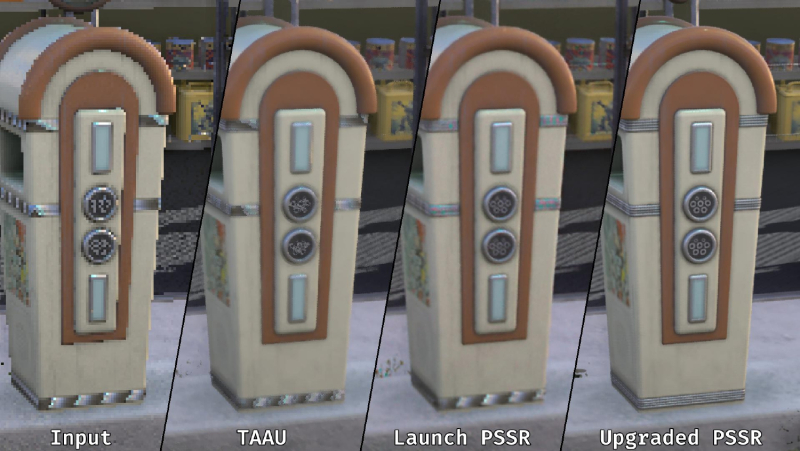
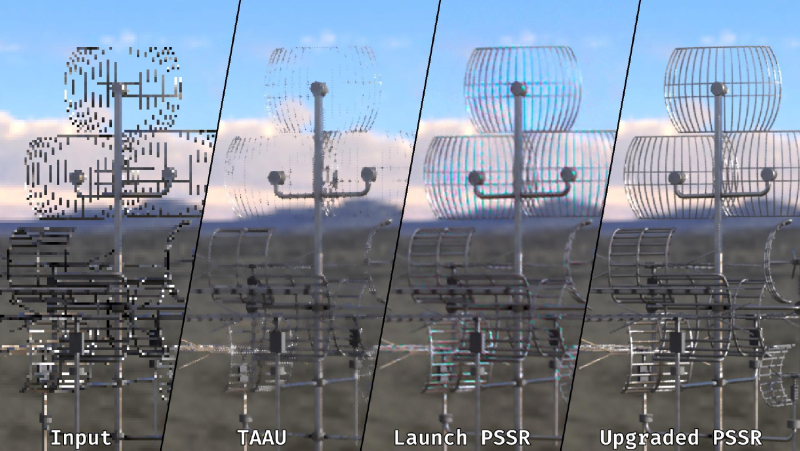
Since the model no longer needed to implicitly manipulate HDR color, it could utilize its capabilities more efficiently. A reworked connection to historical data also improved the gradient flow, allowing the network to learn much longer time dependencies. Sony Interactive Entertainment and AMD engineers additionally implemented an elliptical Gaussian filter in the input space, designed to maintain efficiency as the scaling factor increases, solving the 2.5x and 3x image reconstruction problem in the original model.
The new version was developed by Sony and AMD as part of the Project Amethyst research project, and its implementation is tailored to PlayStation hardware. Existing PS5 Pro games can use Enhanced PSSR via system override without updating the game itself. Developers who directly integrate the latest library will have access to the improved algorithm in its entirety.